The Mysterious Problem: Hot Radiators, Cold Rooms
My old radiators were scalding hot to touch. Surface temperature easily 60-70°C+. Uncomfortable to place your hand on. Clearly heating up, clearly working.
But my rooms took forever to warm up. They never quite felt comfortable. Standing near the radiator felt warm — the rest of the room didn't.
I initially assumed the problems were:
- Radiators too small (BTU output insufficient)
- Air in the system (bleeding didn't help)
- Boiler not powerful enough (but the old 16-22kW had handled it for decades)
- Thermostat problem (it worked fine)
- Heat loss through windows (part of it, but not the main issue)
The real problem? It wasn't about BTU output or boiler power. It was about how the heat was getting into the room. My radiators were producing plenty of heat — they just couldn't effectively distribute it into the living space.
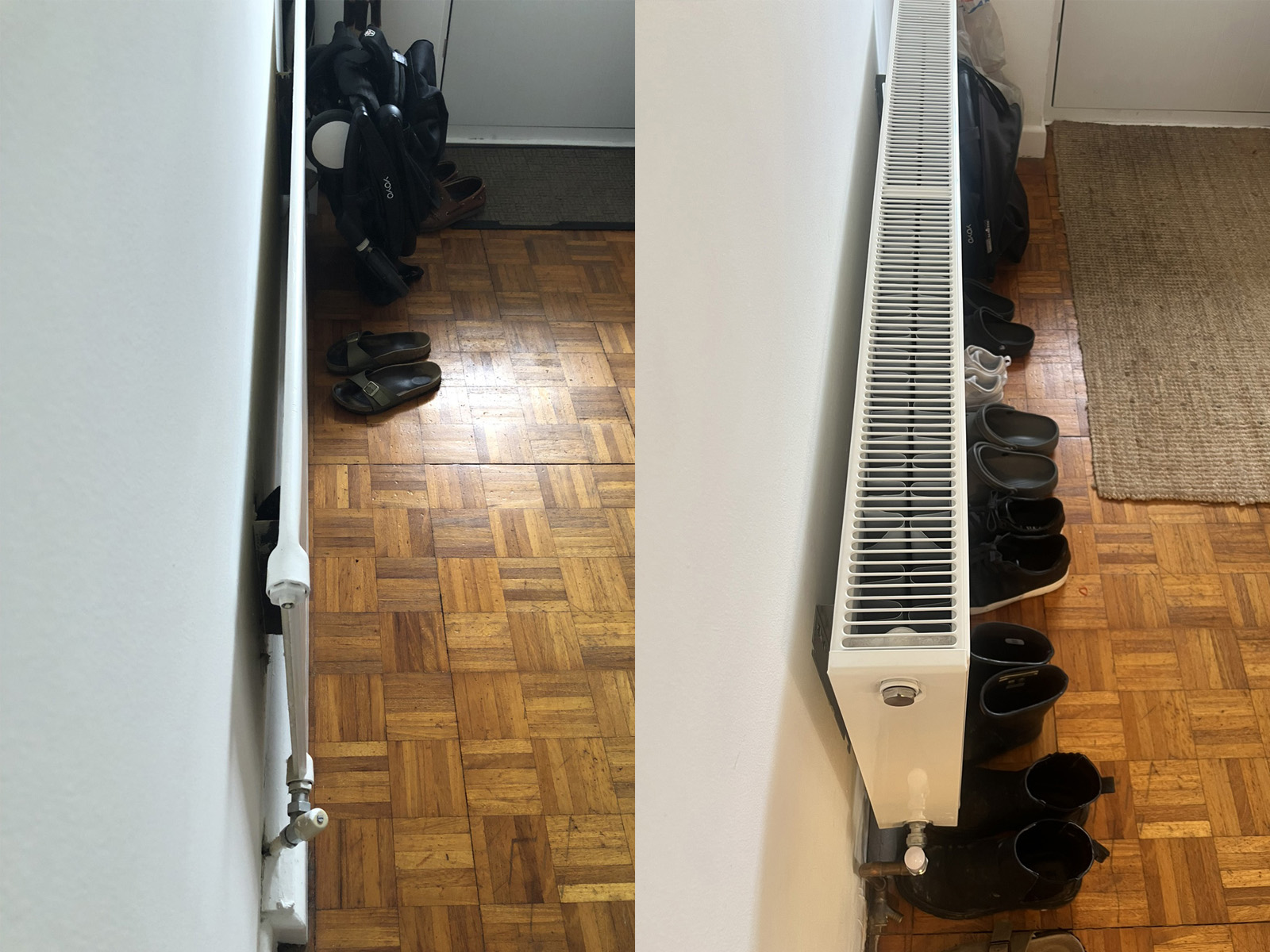
Left: Old T1 flat panel radiator with no convector fins. Right: New T22 radiator with visible convector fins creating air circulation.
Understanding Radiator Types: T1/T2 vs T11/T21/T22
Old Radiator Types (What I Had)
T1 (Single Panel Only):
- One flat panel
- NO convector fins
- Just smooth metal panel facing the room
- Radiates heat from surface only
- Minimal air circulation
- Poor heat distribution throughout room
T2 (Double Panel Only):
- Two flat panels back-to-back
- NO convector fins
- More surface area than T1, but still just radiating from flat surface
- Slightly better than T1, but still poor distribution
Most of my house had T1 radiators — the living room had T2s because it needed the highest BTU output. Despite having the highest output in the house (2,723W combined), those living room radiators got very hot but the room took ages to warm.
Modern Radiator Types (What I Replaced With)
T11 (Single Panel, Single Convector):
- One panel + one set of convector fins
- Slimmest profile (~60mm projection from wall)
- Better heat distribution than any T1/T2
- Good for constrained spaces like bedrooms with tight walkways
T21 (Double Panel, Single Convector):
- Two panels + one set of convector fins between them
- Medium depth (~80mm projection)
- Good balance of output and depth
- I used this for the landing due to geometric constraints
T22 (Double Panel, Double Convector):
- Two panels + two sets of convector fins
- Deepest profile (~100mm projection)
- Maximum heat output and distribution
- I used these in 6 rooms where space allowed
The critical difference: Old T1/T2 have NO convector fins — just flat panels. New T11/T21/T22 ALL have convector fins. This makes all the difference.
What Convector Fins Actually Do
Without Convector Fins (T1/T2)
- Heat transfers from water to metal panel
- Panel radiates heat outward (like a space heater)
- Air near panel warms up slowly
- Warm air rises passively
- Minimal air circulation
- Heat concentrates near the radiator
- Poor distribution throughout the room
With Convector Fins (T11/T21/T22)
- Heat transfers from water to panels AND fins
- Fins are corrugated/zigzag metal between panels
- Creates vertical channels for airflow
- Cold air enters at bottom
- Air passes through fin channels and heats rapidly
- Hot air exits at top
- Creates convection current — acts like a chimney for air
- Continuously pulls cold air in bottom, expels hot air at top
- Much better room circulation
The convector fins create 30-50% more heat transfer to air — not just through higher BTU output, but through better heat distribution. It's like adding 2-3× more radiator surface area in the same physical footprint.
My Real-World Experience: Room-by-Room
Living Room Transformation
Before (T2 radiators): Two double-panel radiators with a combined 2,723W — the highest BTU output in the house. They got very hot, but the room took ages to warm. I had to crank the thermostat higher. Standing next to the radiator felt warm, but the rest of the room didn't.
After (T22 convector radiators): Similar total BTU output, but the room heats much faster and more evenly. The convector fins circulate air throughout the space. No more "hot near radiator, cold across room." Lower flow temps (50°C vs 70°C) work fine because convection is so much more effective.
Landing: From Cold Spot to Comfortable
Before (T1 radiator): Tiny 54×53cm radiator outputting just 242W (826 BTU). Completely inadequate for the space. The landing was always a cold spot.
After (T21 convector): 500×900mm T21 outputting 2,000W+ (3,532 BTU) — an 8× increase in BTU. But the convector fins make it feel like even more. Air circulation throughout the stairwell. No more cold spot.
Bedrooms: Even Heat Distribution
Before: T1 radiators got hot, but rooms took forever to reach target temperature. Heat concentrated near the radiator. Corners and far walls stayed cold.
After: T11 (in master/guest for slim profile) and T22 (in children's rooms) all heat faster and more evenly. Even the slimmest T11 is better than the old T1. The rooms are comfortable throughout — not just near the radiator.
The pattern was consistent in every room: Hot air circulation (not just radiation), faster warm-up times, more even heat distribution, and lower flow temperatures work better because convection is more effective.
Why Old Radiators Were Built This Way
In the 1970s, energy was cheap and efficiency wasn't a priority. High flow temperatures (70-80°C+) were standard because boilers were less efficient anyway — so why not run them hot?
Simple flat panel radiators (T1/T2) were cheaper to manufacture. Convector fins required more materials, more complex manufacturing, and higher costs. During the 1970s housing boom, cost-cutting in volume house building was the norm.
The economic reality was simple: if a room was cold, you just cranked the thermostat higher. Wasting energy didn't matter economically.
What changed: Energy costs rose dramatically. Condensing boilers require lower flow temps for efficiency. Lower flow temps require better heat distribution — enter convector fins. T11/T21/T22 became the norm. T1/T2 became obsolete.
But millions of homes still have old T1/T2 radiators. Many owners don't realize it's the radiator type that's the problem, not just age.
The TRV Problem: Why No Room Control Made It Worse
My old radiators had TWO problems:
- No convector fins (poor heat distribution)
- No TRVs (Thermostatic Radiator Valves)
This meant I had to heat ALL rooms at ALL times. I couldn't control individual rooms. When my living room downstairs got cold and needed heating, I couldn't just turn the heating on — because all radiators would come on together, wasting energy heating the kids' bedrooms upstairs that didn't need it.
My workaround: I deliberately restricted the upstairs radiators so they'd take a long time to heat up. This gave me some control over when to run the heating — but it was still wasteful, just less wasteful than fully heating upstairs.
The vicious cycle: No TRVs meant heat all rooms or none. No convectors meant poor distribution even when heating. Result: crank the thermostat higher, waste energy everywhere, and still be cold in the rooms you're using while overheating rooms you're not.
The solution with new radiators: T11/T21/T22 with convector fins provide better distribution. ALL new radiators have TRVs for independent room control. I can heat downstairs without wasting energy upstairs. Energy efficiency + comfort + control.
How to Tell If You Have This Problem
Signs your radiators lack convector fins:
- Look at radiator from the side: Flat panel(s) only = T1 or T2 (no convectors). Can see zigzag fins between panels = T11/T21/T22 (has convectors).
- Feel the airflow: Hold hand at bottom — if no air being pulled in, no convectors. Hold hand at top — if no hot air blasting out, no convectors. Strong airflow top and bottom = has convectors.
- Check heat distribution: Radiator scalding hot but room stays cold = no convectors. Room heats evenly and quickly = has convectors.
- Age and appearance: 1960s-1980s flat panel radiators = likely T1/T2. Modern radiators almost all have convectors.
What to do: If you have T1/T2 radiators, consider replacement — but not just "new radiators." Specifically T11/T21/T22 with convectors. Don't replace with the same type (won't fix the problem).
The Results: What Changed
Immediate improvements:
- Rooms heat much faster (30-50% faster subjectively)
- Heat distribution throughout room (not concentrated near radiator)
- Can run lower flow temperatures (50°C vs 70°C)
- Boiler more efficient (condensing operation)
- TRVs provide room control (heat rooms you're using)
Energy consumption: I can't isolate radiator replacement alone, but it's part of a 45.4% total reduction over 5 years combined with loft insulation, boiler upgrade, and weather compensation. System efficiency comes from radiators + boiler + controls working together.
Would I do it again? Absolutely yes. Not just "new radiators" but specifically "convector radiators." Understanding T1/T2 vs T11/T21/T22 was key. £682.03 for 10 radiators (Screwfix deal helped). It laid the foundation for overall system efficiency.
Conclusion
My old radiators got scalding hot. My rooms stayed cold.
For years, I assumed the problem was boiler power or radiator size (BTU output). The real problem was radiator design: T1/T2 flat panels with no convector fins. They produced heat — plenty of heat. But they couldn't effectively distribute it into the room.
The solution wasn't bigger radiators — it was smarter radiators:
- T11/T21/T22 with convector fins
- Convector fins create air circulation
- Cold air in bottom, hot air out top
- Continuous convection throughout room
- 30-50% better heat distribution
Combined with TRVs (room control) and lower flow temperatures (boiler efficiency), these convector radiators transformed heating performance.
If your radiators are hot to touch but rooms stay cold, check if they're flat panel T1/T2 types. The problem isn't your boiler or system pressure — it's the radiator design from an era when energy was cheap and efficiency didn't matter.
Modern convector radiators aren't just newer — they're fundamentally better at putting heat where you need it: throughout the room, not concentrated near the radiator.